


Off-frame vs On-frame Modular Homes and Manufactured Homes
Updated: Sep 12
Modular homes can be confusing. Even real estate agents sometimes have difficulty identifying the difference between manufactured homes and on-frame or off-frame modular homes. Unlike site-built homes—often called “stick-built” homes—modular and manufactured homes are delivered to the building site in one or more sections by truck.

Site-built homes are constructed entirely at the building site. Common construction materials include 2 × 4 and 2 × 6 lumber used for framing and trusses. They must conform to applicable state, local, and regional building codes.
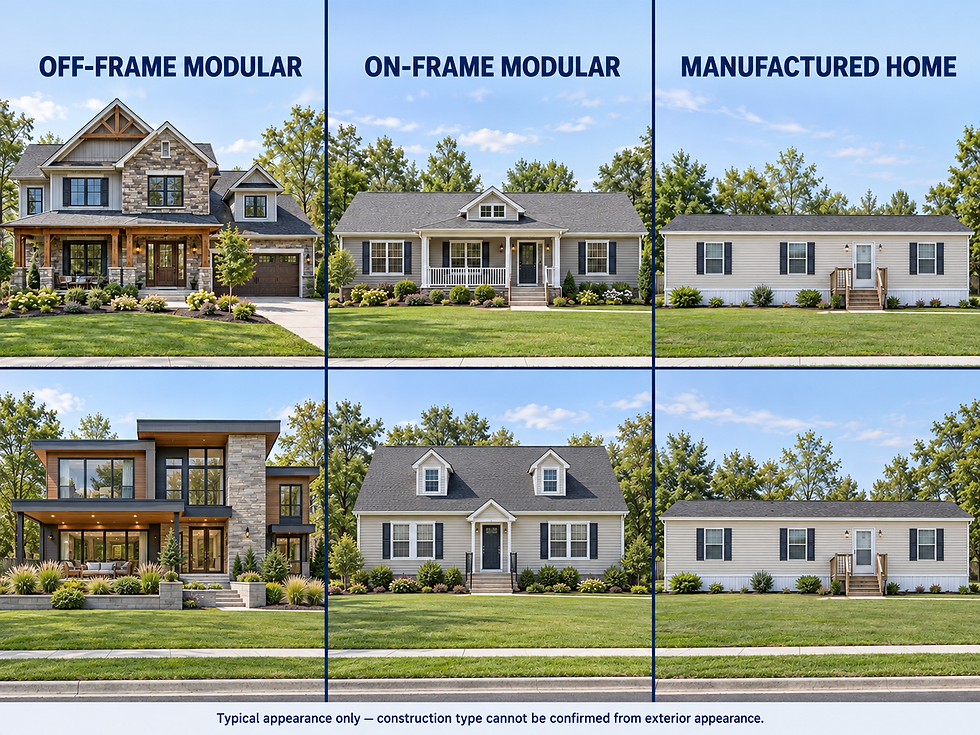
The main difference between an on-frame and off-frame modular home is whether a permanent frame remains beneath the property. You generally cannot determine this from the exterior because the homes may look nearly identical. Other differences can provide useful clues, although they are not always present. The critical distinction: off-frame modular homes are generally appraised like site-built homes, not manufactured homes.

What are modular homes?
Modular homes are built in sections at a factory. This can actually improve the quality of a home, as they are built in a controlled environment.
They are built to conform to all state, local or regional building codes at their destinations.
Sections are transported to the building site on truck beds, then joined together onsite, after which the local building inspectors check the build to make sure that it meets requirements.
Floor-joist sizes and spacing can provide useful clues, but they vary by manufacturer and design and should not be used alone to classify a home.
Some container homes use modular or prefabricated construction methods, but a shipping-container home is not automatically a code-compliant modular home.
Some homeowners associations and restrictive covenants limit modular construction.
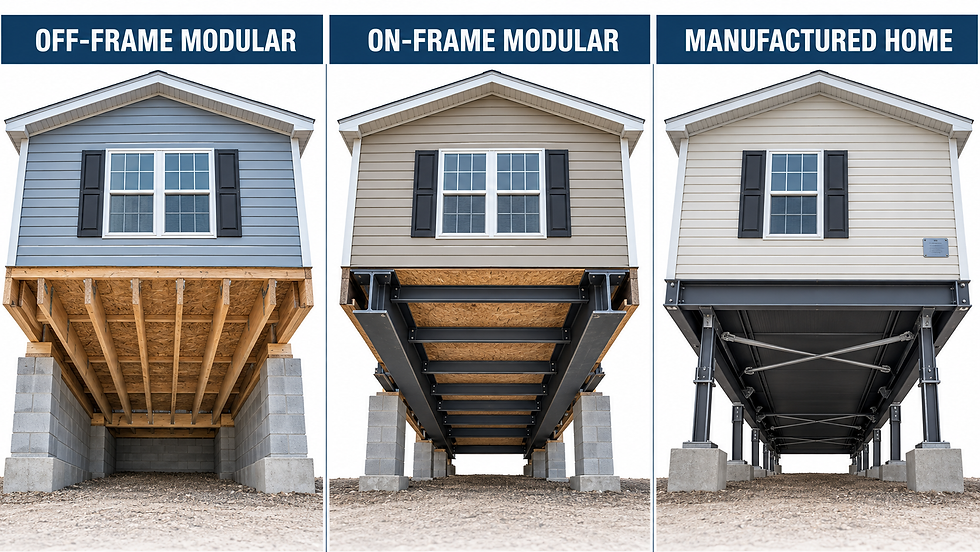
1. Off-Frame Modular Homes:
No steel frame underneath
2″ x 10″ floor joists, occasionally 2″ x 8″
Floor joists are 16″ centers
Built to same residential codes as stick built homes
Generally appraise similarly to site-built homes when they are built to the applicable residential code, permanently installed and supported by appropriate market data. Value can rise or fall with the market and the individual property.
An off-frame modular home is not a manufactured home. It is built to the same state and local residential building codes as a site-built—or “stick-built”—home and is installed on a permanent foundation without a permanent steel transport frame. For appraisal purposes, it is generally evaluated in much the same way as a site-built home, using its quality, condition, location, marketability, and the best available comparable sales. That does not guarantee the same dollar value, but it means the home should not automatically be classified, appraised, or discounted as manufactured housing.
2. On-Frame Modular Homes:
Steel frame underneath
2″ x 6″ or 2″ x 8″ floor joists
Floor joists are up to 24″ centers
Financing depends on the property, permanent foundation, documentation, lender and loan program; an on-frame modular home does not automatically require a manufactured-home loan.
Fannie Mae permits certain qualifying on-frame modular homes to be underwritten and appraised as modular rather than manufactured housing when they comply with local building codes, are permanently attached to an appropriate foundation, use materials comparable to site-built homes, and have the towing equipment removed. However, this does not mean every lender or appraiser will treat an on-frame modular home like a traditional site-built home. Limited documentation, lender requirements, scarce comparable sales, local market perceptions, or misclassification may result in the property being evaluated more like manufactured housing. Buyers and sellers should confirm the classification, available financing, and appraisal requirements with the lender and appraiser at the beginning of the transaction.
3. Manufactured homes
Manufactured homes—often called mobile homes or trailers—are constructed and inspected in the factory under the federal HUD Code. Local officials may inspect the foundation, installation, utility connections and other work completed at the property. A permanent steel chassis remains part of the home.
The permanent chassis may be concealed by skirting or a foundation enclosure.

How to identify a modular home vs a manufactured home
Identification requirements for modular homes vary by state and manufacturer. Check the home’s modular certification label, building permits, plans and manufacturer documentation rather than relying on appearance alone.
For a manufactured home, the paper HUD data plate is usually located near the main electrical panel, inside a kitchen cabinet or in a bedroom closet. It contains the manufacture date and information about installed equipment and the home’s wind, roof-load and thermal zones.
Manufactured homes should have a metal HUD certification label on the exterior of each transportable section. This exterior label is different from the paper data plate located inside the home.
Often the property card will say “modular” without identifying which type, and property records can be incorrect. A manufactured home may be treated as personal property or converted to real property depending on state law, title status, land ownership and how it is permanently installed. Confirm the status with the appropriate county office, lender or closing professional.
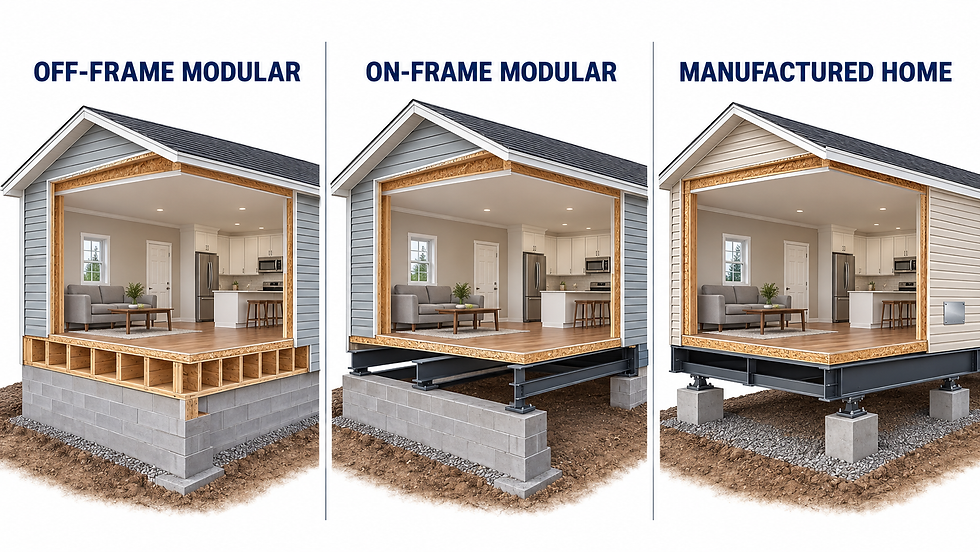
Under the home
Brick or masonry around the perimeter may be decorative skirting rather than a structural foundation. Manufactured homes retain a permanent steel chassis, although the chassis may be difficult to see. Former wheel, axle or hitch attachment points may also be visible. Anchoring and foundation systems vary, so tie-down straps and other components will not always be readily apparent.
Government-backed and conventional financing may be available for qualifying modular and manufactured homes. Eligibility depends on the home’s classification, age, permanent foundation, title and real-property status, appraisal, location, borrower qualifications, lender and loan program. Confirm the requirements with the lender before making an offer.
FHA — May be available subject to the home, borrower and foundation requirements.
VA — May be available to eligible borrowers when the property meets current program requirements.
USDA — May be available for qualifying new or existing modular and manufactured homes, subject to current property, borrower, location and lender requirements.
Off-frame modular homes generally have access to financing similar to site-built homes, subject to the property, appraisal, documentation, lender and loan program.
Why I have always liked modular construction
Coming originally from Europe, I have long been a fan of modular homes. Modular construction is much more familiar in many parts of Europe, and I have never completely understood the stigma it sometimes carries in the United States.
A modular home is not automatically better simply because it was built in a factory—the manufacturer, materials, design, foundation and onsite installation all matter. However, building inside a protected environment can offer real advantages. Materials are not left exposed to months of rain, snow and changing temperatures, and the construction process can allow for more consistent quality control.
When you think about it, almost every home is ultimately a collection of framed spaces—or boxes—joined together. With traditional construction, those spaces are assembled at the building site. With modular construction, much of that work is completed indoors before the sections are transported and joined together onsite.
To me, there is a great deal of common sense in constructing those sections in a controlled environment rather than leaving the framing exposed to the weather during a lengthy building process. That does not make every modular home superior, but it is one reason I believe well-built modular homes deserve to be evaluated on their actual quality—not dismissed because of an outdated perception.
For a fuller picture, see the advantages and potential drawbacks in the “Pros and cons of modular homes” section below.
Visual tips: on-frame versus off-frame
Off-frame modular: Underneath the home, you should generally see a conventional wood floor system supported by the permanent foundation. No permanent steel transport chassis remains beneath the home.
On-frame modular: Parallel steel beams and crossmembers remain beneath the home as part of its structure. The wheels, axles, and towing hitch are normally removed, but their former attachment points may still be visible.
Manufactured home: Also retains a permanent steel chassis. Therefore, finding steel underneath does not by itself distinguish an on-frame modular home from a manufactured home.
Labels provide stronger evidence
Let's take North Carolina as an example:
A modular home should have a roughly 2×2-inch reflective silver North Carolina Modular Construction Validating Stamp inside, normally beside its data plate.
A manufactured home should have a metal HUD certification label on the exterior of each transportable section.
Manufactured-home serial numbers must be stamped into a steel crossmember. An on-frame modular may have a stamped serial number there, but it is not required.
The North Carolina Office of State Fire Marshal identification guide confirms these distinctions. HUD also explains the exterior certification label and interior data plate.
Do not rely solely on brick skirting, roof style, porches, home width, or how permanent the house looks. Even floor-joist sizes and spacing are clues rather than universal rules.
Outside North Carolina: Modular-home labels vary by state and may be called a validation stamp, insignia, decal, seal, or manufacturer’s certificate. Search online for “[your state] modular building program label” or “[your state] modular home insignia,” and use the official state building-code, housing, community-affairs, or fire-marshal website. If your state does not administer a statewide modular program, contact the local building department where the home was installed. Ask what label or documentation was required when the home was built, because requirements and label designs can change over time.
HUD-code manufactured homes are different: their exterior certification labels are federally regulated and used nationwide. HUD explains those labels and interior data plates here.
Construction type is only one part of the decision. Before buying, building or selling one of these homes, it is important to consider the practical advantages and possible drawbacks.
Pros and cons of modular homes
Modular construction can offer real advantages, but the complete picture depends on the home, manufacturer, building site, local regulations and available contractors.
Potential advantages
Controlled construction environment: Materials are protected from prolonged exposure to rain and weather while the home is being built.
Consistent quality control: Factory processes and inspections can create more consistent construction conditions.
Potentially shorter construction schedule: Factory construction and site preparation may occur at the same time, although permitting, site work and contractor availability still affect timing.
Design flexibility: Modular construction can range from modest homes to large, highly customized designs.
Site-built treatment for qualifying off-frame homes: Off-frame modular homes are generally appraised and financed similarly to site-built homes, subject to the property, documentation, market evidence, lender and loan program.
Potential drawbacks
Transportation and installation costs: Delivery, crane work, foundation construction, grading, utilities and site preparation can add substantially to the total price.
Site-access limitations: Narrow roads, steep terrain, bridges, trees and limited turning space can make delivery difficult—especially in mountain communities.
Zoning and association restrictions: Local rules or homeowners association covenants may limit modular construction.
Financing, appraisal and insurance confusion: Incomplete records or an incorrect property classification can create delays, particularly when an on-frame modular home is mistaken for manufactured housing.
Changes can become expensive: Once factory construction has begun, design changes may be more difficult or costly.
Resale perceptions: Some buyers and real estate professionals still misunderstand modular construction, making accurate documentation and marketing especially important. There can be a stigma regarding modulars, particularly on-frame modulars.
Compare the complete installed cost—not simply the factory price—and verify the building code, foundation, permits, warranty, financing and insurance before moving forward.
The bottom line
A modular or manufactured home should not be judged by appearance—or by a single word in the property records. Confirm the applicable building code, permanent frame, labels, permits, foundation, title status and manufacturer documentation.
Buyers should also verify financing, insurance and appraisal requirements with the appropriate professionals before making an offer.
If you are buying or selling a modular or manufactured home, call Allstar Powerhouse at 828-333-4483 to be connected with your local Allstar agent. We can help you identify the right questions, review the available property information and connect you with the appropriate lender, appraiser or inspector.
Updated September 2026. This article provides general real-estate information and is not legal, engineering, lending, insurance or appraisal advice.
Check out all of our Pros and Cons articles



Comments